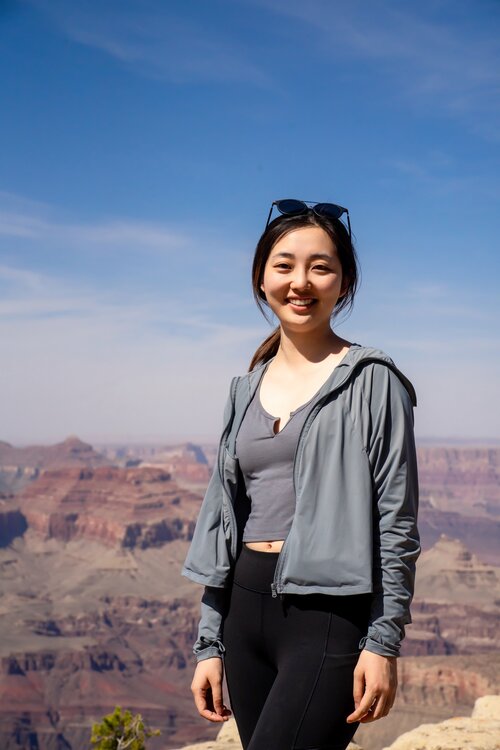
 Wei Hu is a Ph.D. student in the Department of Geography and Geographic Information Science at University of Illinois Urbana–Champaign (UIUC). Within I-GUIDE, Wei contributes research to the Geospatial Knowledge Hypercube and is a member of the I-GUIDE Climbers group and the Geospatial AI and Data Science Team.
What is your current position and institutional affiliation(s)?
I am a Ph.D. student in the Department of Geography and Geographic Information Science at UIUC.
What is your role in I-GUIDE?
Within I-GUIDE, I serve as both a student researcher and an organizer. My research is centered on the AI and Geospatial Knowledge Hypercube, with the goal of transforming unstructured text into structured, analyzable geospatial data to support knowledge discovery. Within this framework, I work on extracting geospatial information such as locations and topological relationships from text, and applying the resulting representations to the study of global earthquake news coverage. In addition, I serve as an organizer for I-GUIDE–related sessions and activities at the AAG Annual Meetings in 2025 and 2026, and I serve on the technical committee for I-GUIDE Spatial AI Challenge for the 2024–2025 and 2025–2026 cycles.
Did you start your academic career with the same goals and direction as you have now? If not, tell us a little about how and why your direction has changed?
My academic direction has been evolving over time. I started with a strong interest in technical work, especially model development, often focused on improving accuracy on benchmarks. Through interdisciplinary experiences with I-GUIDE, I became more focused on using these technical tools to address real-world scientific problems. Advances in AI have drawn me slightly back toward technical, but with a different mindset—one that emphasizes thinking carefully about which problems are worth solving and how technical advances can meaningfully contribute to scientific understanding. It is challenging, but it keeps my work engaging.
What inspires you and motivates you to do the work that you do?
I am motivated by questions that connect technical work with real-world impact. Disasters and crisis events, in particular, reveal large inequalities in how information is produced, shared, and accessed across places. Being able to use geospatial data and computational methods to better understand these patterns—and to turn complex, unstructured information into something that can be systematically studied—keeps me engaged. I am also inspired by interdisciplinary collaboration, where different perspectives help refine both the questions we ask and the methods we use.
Do/did you have a Plan B? What do you think you’d be doing if you hadn’t chosen an academic career?
Yes, I would likely be working as a data scientist or research engineer in industry. I enjoy working with technology and continuously learning new things, which keeps me motivated.
What is the next chapter (aspirational or planned) in your career?
I am still focused on my Ph.D. work and have not yet settled on a specific post-graduation plan. For now, I am continuing to strengthen both my technical skills and my ability to ask meaningful scientific questions.
What would you like to be when you grow up?
I would like to be someone who continues learning. More than a specific title, I value doing thoughtful work that connects technical skills with meaningful societal questions. A professor would naturally fit this role, but the work itself matters more than the title.